The introduction of smart lighting systems can generate energy savings of up to 70-80% compared to traditional systems, depending on the application area
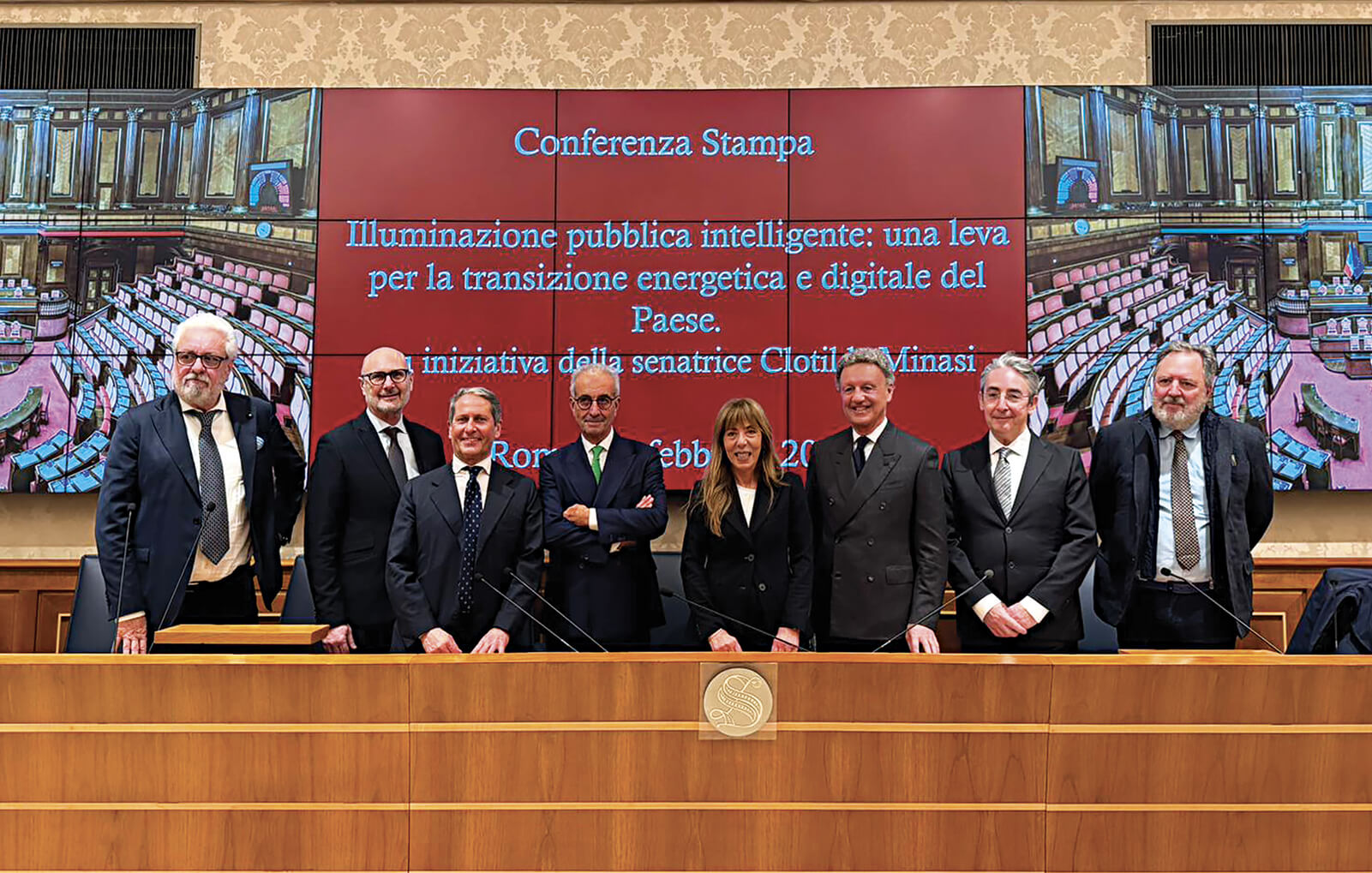
The press conference “Illuminazione pubblica intelligente: una leva per la transizione energetica e digitale del Paese” (Smart public lighting: a lever for the country’s energy and digital transition), promoted on the initiative of Senator Clotilde Minasi, was held at the Sala Caduti in Nassirya. The meeting was an important opportunity to discuss the potential of advanced lighting technologies, starting from the study ASSIL – Associazione dei produttori di illuminazione – carried out in collaboration with the Politecnico di Milano.
This is the context of Disegno di Legge No. 1700 of the XIX Legislature, deposited in the Italian Senato, entitled “Disposizioni per l’efficientamento dell’illuminazione pubblica e degli edifici pubblici attraverso la promozione di sistemi di illuminazione digitalizzati di ultima generazione” (Provisions for improving the efficiency of public lighting and public buildings through the promotion of latest-generation digital lighting systems).
The measure aims to provide a clear reference framework on the best technologies available today to modernise the lighting infrastructures of the public sector, significantly contributing to energy consumption and emissions reduction. The regulatory proposal aims to encourage the adoption of intelligent and digitised lighting systems, based on LED technologies, brightness sensors and remote management platforms, capable of integrating monitoring, automation and predictive maintenance functions. The objective is twofold: on the one hand, to reduce management and maintenance costs for public administrations, on the other hand, to improve safety, service quality and environmental sustainability through centralised and intelligent control of lighting networks.
According to the ASSIL study carried out in collaboration with the Polytechnic, there are about 10 million public lighting spots in Italy, of which 65% have already been converted to LED technology. Future interventions will therefore have to focus on the remaining 35%, equal to about 3.5 million light spots. The study outlines three development scenarios: from the basic, more conservative scenario, which involves the simple replacement of obsolete lighting fixtures with LED solutions, to the advanced scenario, featured by a high-tech evolution of public lighting. In the latter case, the complete LED conversion is accompanied by a widespread diffusion of intelligent systems, consistent with the principles of smart cities and with the objectives of the EPBD directive.
In terms of energy and environmental benefits, the baseline scenario would save 1.7 GWh, equivalent to planting around 11,950 trees per year and reducing 424 tonnes of CO₂. The advanced scenario would instead lead to a saving of 2.4 GWh, equal to 17,435 equivalent trees and a decrease of 619 tons of CO₂.
Public outdoor lighting is just one example of this measure’s tangible benefits. It could generate a significant multiplier effect of opportunities, also in relation to the enhancement and management of the State’s state-owned assets. The introduction of smart lighting systems can indeed generate energy savings of up to 70-80% compared to traditional systems, depending on the application area This Disegno di Legge – at no cost to public finances – is fully part of the digital and ecological transition of the country’s urban infrastructures and represents an actual step towards the creation of a national network of “smart” public lighting and public buildings, consistent with the principles and objectives of the Piano Nazionale Integrato Energia e Clima (PNIEC), which envisages a significant reduction in greenhouse gas emissions by 2030. Within six months of the text approval, the State-Regions Conference will have to adopt the national guidelines for the efficiency of public lighting and public buildings, promoting the use of the latest generation digitised systems. The guidelines will be updated every three years, in order to ensure constant alignment with technological evolution and with the best European practices in the field of smart lighting.
“The presentation of this Disegno di Legge represents an important theme for the diffusion of quality lighting technologies. ASSIL strongly supports a measure that finally defines a clear reference framework for modernising public infrastructure, transforming lighting from a simple cost item to a strategic lever for the country’s digital and ecological transition,” says Carlo Comandini, President of ASSIL.