
The World High-End Design Furniture Market: Distribution Strategies and Potential Cities – Report by CSIL
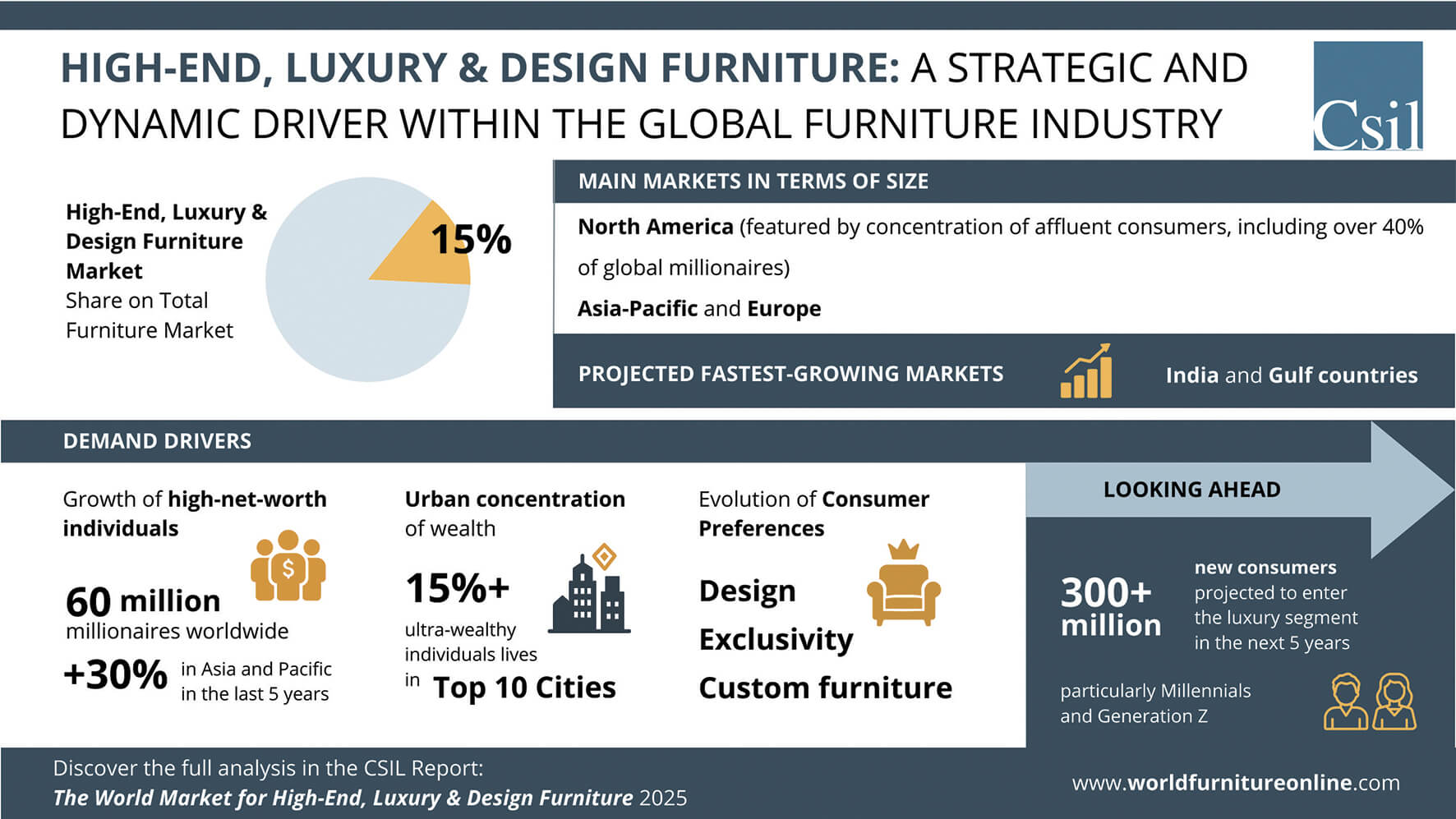
Accounting for nearly 15% of the world’s furniture market, according to CSIL’s latest data, the high-end furniture market emerges as a strategic and dynamic driver within the global furniture industry.
North America is the largest market, largely due to its concentration of affluent consumers, including over 40% of global millionaires. Asia-Pacific and Europe follow in market size, while India and the Gulf countries stand out among the fastest-growing regions, driven by wealth concentration, urban development, ambitious real estate investments, and evolving lifestyles. Despite ongoing uncertainty, rapid transformation, and geopolitical challenges, the high-end segment has demonstrated greater stability and independence from short-term fluctuations, such as trade shocks, and has been driven by long-term structural trends: growth of high-net-worth individuals (nearly 60 million of millionaires worldwide, +30% in Asia and Pacific in the last five years), urban concentration of wealth (top 10 cities in the world are home to more than 15% of global ultra-wealthy individuals), and the evolution of consumer preferences toward design, exclusivity and custom furniture. Those have favoured a customer base expansion globally.
In this scenario, companies are shaping their strategies. The global high-end furniture market is formed by a fragmented and diverse competitive landscape, spanning from artisan-led ateliers to global lifestyle brands. Companies differentiate not only through product and price, but through brand positioning, design ethos, customer focus, and distribution models.
In its comprehensive report ‘The World Market for High-End, Luxury & Design Furniture’ (July 2025), CSIL did an in-depth analysis of distribution strategies for the leading 45 high-end design and fashion brands, selected based on their strong brand recognition and the presence of a well-established international distribution network, encompassing both flagship/monobrand stores and a wide base of dealers. When it comes to leading brands, Carl Hansen & Søn, Vitra, Fritz Hansen, Calligaris, and Cassina currently rank among the top in terms of total retail presence. While Carl Hansen & Søn and Vitra lead due to extensive dealer networks, brands such as Cassina, Kartell, Molteni, and Poltrona Frau combine strong distribution with a high number of monobrand stores or branded spaces, reflecting their dual strategy of global reach and premium positioning.
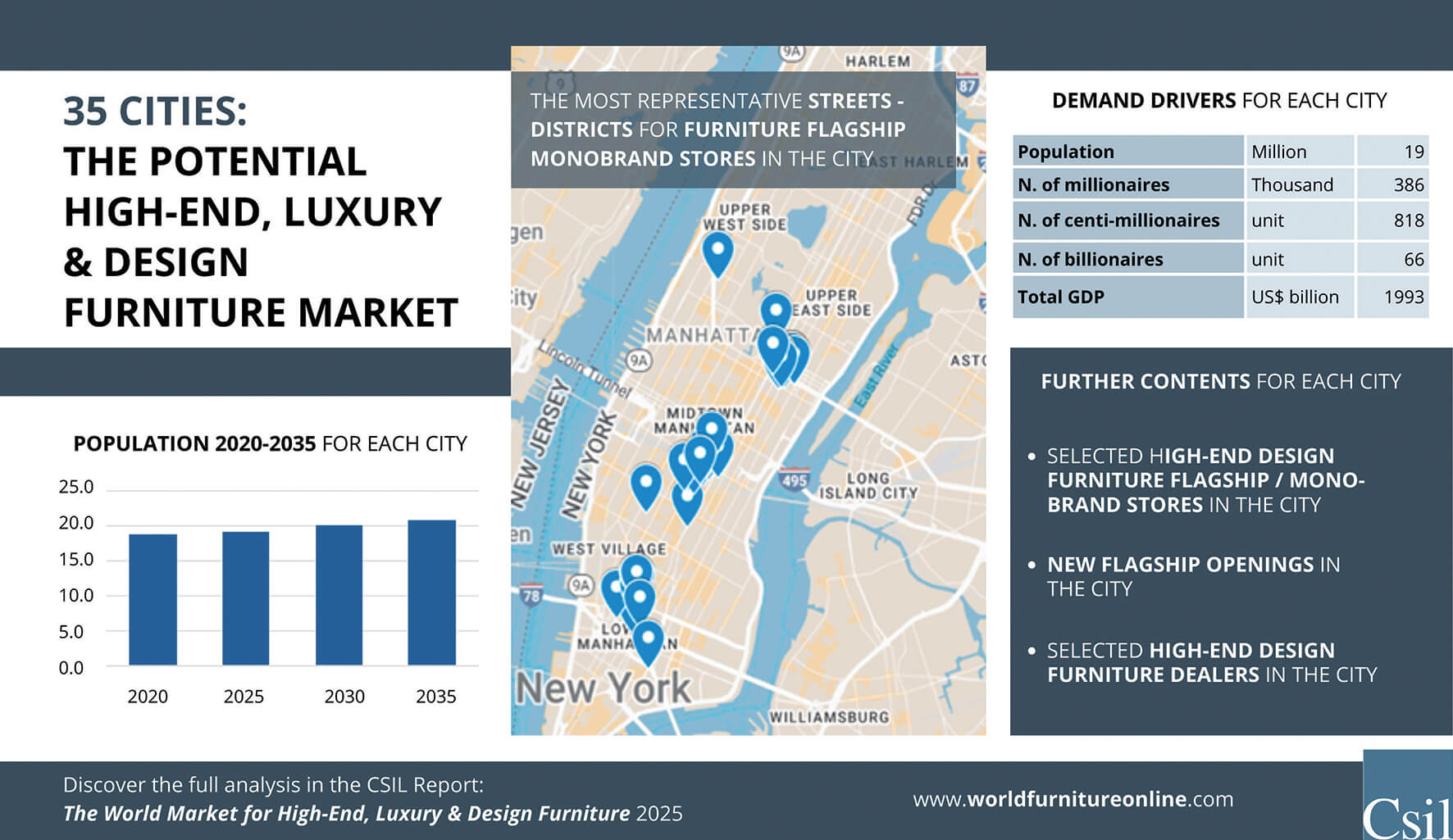
Generally, there is a growing focus on geographic diversification, particularly toward high-growth regions. Mature markets like Europe, while still important (accounting for nearly half of all flagship / monobrand locations), offer limited short-term upside. In contrast, regions such as India, the Gulf countries, and Southeast Asia are drawing increased attention, especially in metropolitan areas, driven by growing affluent consumer bases and architectural projects. Companies are responding by opening new showrooms, enhancing local distribution networks, and investing in local partnerships. Italian brands have seen robust growth in India, while European suppliers remain key players in Gulf markets, where demand is buoyed by urban expansion, luxury tourism, and economic diversification programs. North America holds 15% of total flagship stores, showing consistent importance, particularly for Italian and Scandinavian brands expanding in major U.S. cities. The presence of those international brands with flagship / monobrand stores has been a crucial criterion to select the 35 most promising cities worldwide for the high-end furniture market.
Cities play a central role in the global high-end furniture landscape. Far beyond being simple points of sale, metropolitan centres are the convergence zones for wealth, design culture, architecture, real estate development, and international visibility. They are where demand concentrates, trends emerge, and brand identities are most powerfully expressed.
Global capitals like New York, London, Paris, Milan, and Tokyo remain the cornerstone markets for high-end furniture. With dense networks of showrooms, luxury retailers, architects, and affluent clients, these cities blend design heritage with strong purchasing power. In the analysis of 45 leading international brands, about 190 flagship stores are in those cities. Flagship stores here function not just as retail spaces, but as immersive brand experiences. Brands such as Poliform, Minotti, and B&B Italia have invested heavily in iconic showrooms located in central design districts, often collaborating with leading architects to enhance experiential impact. Emerging urban powerhouses such as Dubai, Mumbai, Shanghai, and Singapore are rapidly gaining prominence. Fuelled by rising wealth and ambitious development, these cities are investing in luxury real estate, hotels, and branded residences, making them prime targets for expansion, particularly in the contract and project sectors. Their younger, design-curious populations further enhance long-term potential. Flagship store presence in these markets is expanding, but companies also rely heavily on local partners, joint ventures, and project-based channels, especially for contract business.
Meanwhile, emerging design capitals like Los Angeles, Miami, Berlin, Seoul, and São Paulo serve more focused roles. Often hubs for art, culture, and creative industries, they attract niche, design-conscious clientele and are ideal settings for new retail formats, pop-ups, and designer collaborations. These cities are often used as testing grounds for experimental retail, including pop-up stores, concept showrooms, and cross-sector collaborations (e.g., with fashion, art, or lifestyle brands).
Report by CSIL
July 2025, XI Ed. – 232 pages
Language: English
The CSIL’s report ‘The World Market for High-End, Luxury & Design Furniture’ offers a comprehensive in-depth analysis of the high-end furniture market worldwide providing: market size (2019-2024) and forecasts 2025, 2025-2028 at world, area and country level; analysis of the main demand drivers; breakdown of the market by product and end-user; in-depth analysis of the competition, clustering main players by their market of reference, M&A activity and retail strategies; profiles of 35 world’s cities selected for potential high-end furniture demand.
An Executive Summary shows major insights and trends shaping the global high-end furniture sector and the main findings of CSIL’s analysis, delving into drivers and key factors fuelling demand, such as global wealth distribution, the number of millionaires and billionaires, luxury tourism, branded residences, and the superyacht industry, with companies’ features and strategies.
Global analysis of the high-end, design, luxury furniture market, including:
The high-end, design, luxury furniture market is analysed by area and for selected countries, including:
Geographical coverage
European Union + UK, NO, CH; Central and Eastern Europe; North America; Asia and Pacific; South America; Middle East and Africa/Gulf countries.
Country level: Germany, UK, France, Italy, USA, Canada, China, Japan, India, South Korea, Gulf Countries, Brazil, Russia. *For Russia, only sector basic data is available; for South Korea, high-end furniture manufacturers are not available.
This part includes CSIL’s analysis of selected 35 world’s cities based on criteria such as the number of ultra-rich individuals, economic growth, and the presence of high-end brands, together with the distribution analysis of 45 leading international high-end design brands.
More than 500 flagship/ monobrand stores have been identified, together with more than 1300 dealers.
High-end design /fashion brands considered in the distribution analysis: Antonio Lupi; Arclinea; Armani Casa; Arper; B&B Italia; Bentley Home; Boffi|DePadova; Bugatti Home; bulthaup; Calligaris; Cappellini; Carl Hansen & Søn; Cassina; Cattelan; Ceccotti; Cinna; DeSede; Dolce&Gabbana Casa; Edra; Fendi Casa; Flexform; Fritz Hansen; Henge; JANUS et Cie; Kartell; Lago; Lema; Ligne Roset; Luxence-Luxury Living; Minotti; Molteni; Muuto; Poggenpohl; Poliform; Poltrona Frau; Rimadesio; rochebobois; SieMatic; Trussardi Casa; Turri; UniFor; Versace Home; Visionnaire; Vitra; Walter Knoll;
For a detailed description, please visit here
Stay ahead of CSIL’s Furniture Market Research by registering here